Intel 80386: The Revolutionary CPU That Brought the PC Into the Modern Era
Intel 80386: The Revolutionary CPU That Brought the PC Into the Modern Era
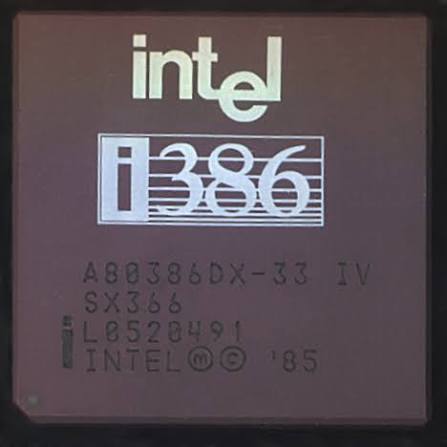
When the Intel 80386 (commonly called the "386") arrived in 1985, it represented far more than a routine processor upgrade. It transformed the IBM PC-compatible computer from a machine constrained by the limitations of the early 1980s into a platform capable of supporting sophisticated operating systems, multitasking, virtual memory, and large software applications.
Many of the concepts that modern x86 processors still use today can trace their roots directly to the 80386. It was arguably the processor that turned personal computers into serious computing machines.
The World Before the 386
Before the 80386, most PCs used processors such as:
Intel 80286.
These CPUs were powerful for their time, but they suffered from significant limitations.
The 8086 and 8088 were fundamentally 16-bit processors with a maximum address space of only 1 MB. The 80286 improved performance and introduced protected mode, but it still had architectural restrictions that made advanced operating systems difficult to implement.
As software became more demanding, developers needed: More memory, Better multitasking, Improved protection between programs, More efficient operating systems The answer was the 80386.
Key Specifications: Release Year: 1985 Architecture: x86 data Bus: 32 bit
Registers: 32 bit Address Bus: 32 bit Maximum Memory: 4 Gb Transistors~275,000 Initial Clock Speeds:12–33 MHz
At the time, addressing 4 gigabytes of memory seemed almost unimaginable. Most PCs shipped with less than 1 MB of RAM.
The Big Leap: True 32-Bit Computing The most important advancement was the move to a full 32-bit architecture. Previous x86 processors had 16-bit general-purpose registers: AX BX CX DX
The 80386 expanded them to 32 bits: EAX EBX ECX EDX The "E" stood for "Extended."
Diagram:
16-bit AX register:
+----------------+ | AX | +----------------+
32-bit EAX register:
+--------------------------------+ | EAX | +--------------------------------+
Lower 16 bits AX This seemingly simple change dramatically increased computational power and efficiency.
One of the most revolutionary features was its ability to directly address 4 gigabytes of memory.
Memory addressing evolution:
8086 └─ 1 MB
80286 └─ 16 MB
80386 └─ 4 GB
Numerically: 20-bit addressing 2^20 = 1,048,576 bytes ≈ 1 MB
32-bit addressing 2^32 = 4,294,967,296 bytes ≈ 4 GB
In 1985, 4 GB felt almost limitless.
Advanced Protected Mode
The 80286 introduced protected mode, but the 80386 made it practical.
Protected mode provided Memory protection, Process isolation, Privilege levels, Hardware multitasking support.
If Program A crashed, it was less likely to bring down the entire system. This became a foundation for modern operating systems.
Virtual Memory The 80386 introduced paging support. Instead of requiring every memory address to correspond directly to physical RAM, the CPU could translate addresses through page tables.
This allowed Larger applications, Better multitasking, Memory protection, More efficient resource use. Modern operating systems still rely on this concept. Virtual 8086 Mode One particularly clever feature was Virtual 8086 Mode. It allowed old DOS software to run inside protected mode.
Impact on Operating Systems The 80386 enabled operating systems that had previously been impractical on PCs. Examples included Early versions of Windows NT, OS/2, UNIX variants, 386-enhanced Windows 3.x, Linux (later in the early 1990s). These systems relied heavily on 32-bit addressing, Protected mode, Paging, Virtual memory. Without the 386, the modern PC software ecosystem would have developed very differently. The 386DX and 386SX Intel later released two major variants.
32-bit data bus 386SX: 32-bit internal CPU 16-bit external data bus
Diagram:
386DX CPU ======== Memory 32-bit
386SX CPU ==== Memory 16-bit
The SX version was cheaper and allowed manufacturers to build lower-cost systems while retaining much of the 386's software compatibility.
Why the 80386 Was Revolutionary The 80386 introduced several technologies that remain fundamental today:
✓ 32-bit architecture
✓ Large memory addressing
✓ Virtual memory
✓ Paging
✓ Protected mode
✓ Process isolation
✓ Backward compatibility
✓ Foundation for modern operating systems
Legacy
Unlike many processors that simply improved speed, the 80386 changed what personal computers were capable of doing. Every modern x86 processor—from the Pentium series to contemporary Intel Core and AMD Ryzen CPUs—still carries architectural DNA inherited from the 80386.
Features introduced by the 386 became permanent pillars of PC computing:
80386 | +--> 486 | +--> Pentium | +-->
Modern x86 CPUs
More than forty years after its introduction, the 80386 remains one of the most influential microprocessors ever created. It bridged the gap between the simple personal computers of the early 1980s and the powerful multitasking systems we use today, making it one of the true milestones in computing history.
Related articles
The Pentium CPU Revolution // Part-4
From Pentium to Modern CPUs: The Legacy of a Revolution
The Pentium CPU Revolution // Part-3
From Pentium to Modern CPUs: The Legacy of a Revolution
The Pentium CPU Revolution // Part-2
Part 2 – Inside the Pentium: The Architecture That Changed CPU Design