Intel 80486: The Processor That Brought PCs Into the Modern Era
Intel 80486: The Processor That Brought PCs Into the Modern Era
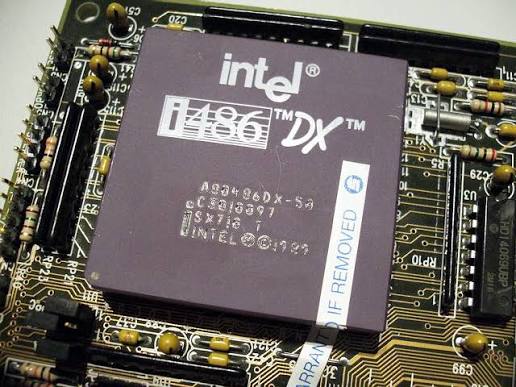
When people discuss the evolution of personal computers, attention often goes to processors such as the Pentium or the original IBM PC's 8088. Yet one of the most important milestones in x86 history was the Intel 80486, commonly known as the "486."
Introduced in 1989, the 80486 represented a major leap forward in performance and integration compared to its predecessor, the Intel 80386. It became the foundation of high-performance desktop PCs throughout the early 1990s and helped establish many architectural features that remain relevant in modern processors.
Historical Background
The Intel 80386 had introduced the 32-bit x86 architecture to personal computers, providing advanced memory management, multitasking capabilities, and a flat 32-bit programming model. While revolutionary, the 386 still relied heavily on external support chips and required many clock cycles to execute common instructions.
The 80486 improved upon the 386 design while remaining fully compatible with existing software. Users could run the same operating systems and applications, but with significantly higher performance. Systems based on the 486 quickly became popular for graphical user interfaces such as Microsoft Windows, CAD software, engineering applications, and gaming.
Architectural Overview
The 80486 is a 32-bit CISC (Complex Instruction Set Computer) processor belonging to the x86 family. It executes the same instruction set as the 386 while introducing several important architectural enhancements.
Some key specifications include:
+32-bit internal architecture
+32-bit data bus
+32-bit address bus capable of addressing up to 4 GB of memory
Integrated floating-point unit (on DX models)
+Integrated 8 KB L1 cache
+Five-stage instruction pipeline
Clock frequencies ranging from 20 MHz to over 100 MHz in later versions
The processor contained approximately 1.2 million transistors, a significant increase over the 275,000 transistors found in the 80386.
Internal Registers
Like the 386, the 80486 uses a set of 32-bit general-purpose registers:
+EAX :Accumulator register
+EBX :Base register
+ECX :Counter register
+EDX :Dataregister
+ESI :Source index
+EDI :Destination index
+EBP :Base pointer
+ESP :Stack pointer
The processor also includes:
Instruction Pointer - EIP (Extended Instruction Pointer) for holding the address of the next instruction to execute.
Flags Register :EFLAGS
Contains status and control bits such as:
+Carry Flag (CF)
+Zero Flag (ZF)
+Sign Flag (SF)
+Overflow Flag (OF)
+Interrupt Flag (IF)
Segment Registers
The 486 continues to support x86 segmentation through:
CS (Code Segment)
DS (Data Segment)
ES (Extra Segment)
SS (Stack Segment)
FS and GS (additional segment registers introduced with the 386)
Control Registers
The processor uses control registers for memory management and operating system functions:
CR0: Enables protected mode and paging
CR2: Stores page-fault address
CR3: Page directory base register
These registers allowed advanced operating systems to implement virtual memory and multitasking efficiently.
Internal Pipeline
One of the most important innovations of the 80486 was its five-stage instruction pipeline.
The stages were approximately:
Fetch 1, Fetch 2, Decode, Execute, Write Back.
Because multiple instructions could be in different stages simultaneously, the CPU achieved much higher throughput than the 386. For simple instructions, the processor could complete nearly one instruction per clock cycle under ideal conditions.
Integrated Cache
The 80386 relied entirely on external memory accesses, which were relatively slow. The 80486 introduced an on-chip 8 KB Level-1 cache. This cache stored frequently used instructions and data directly on the processor die, greatly reducing memory latency.
Benefits included:
Faster program execution, Reduced motherboard complexity, Better overall system, responsiveness.
Today, on-chip caches are standard in all CPUs, but the 486 helped make this feature mainstream in personal computers.
Integrated Floating-Point Unit
A major improvement over the 386 was the integration of the floating-point unit (FPU).
80386 Approach
The 386 required an optional external coprocessor:Intel 80387. Users who needed fast mathematical calculations had to purchase the separate chip.
80486DX Approach
The 486DX integrated the FPU directly onto the processor die.
Advantages included:
Faster floating-point operations, Lower communication overhead, Reduced system cost, Improved scientific and engineering performance.
This was especially beneficial for CAD software, simulations, and 3D graphics applications.
Memory Management
The 80486 retained and improved the advanced memory features introduced by the 386.
Capabilities included:
Protected mode operation
Virtual memory support
Paging
Privilege levels (Ring 0–Ring 3)
Hardware task switching
The paging unit translated virtual addresses into physical addresses using page tables, enabling sophisticated multitasking operating systems.
Why the 80486 Was Better Than the 80386
1. Built-In Cache
The integrated 8 KB cache dramatically reduced memory access times.
2. Instruction Pipeline
The 486's pipelined architecture allowed much higher instruction throughput.
3. Integrated FPU
The 486DX eliminated the need for a separate 80387 coprocessor.
4. Higher Performance per Clock
A 25 MHz 486 often delivered performance comparable to a much faster-clocked 386 system.
5. Improved Bus Interface
The processor handled memory accesses more efficiently, reducing bottlenecks.
6. Greater Integration
Many functions previously implemented with external chips were moved onto the CPU itself, lowering system complexity and improving reliability.
Variants of the 80486
Several versions of the processor were released:
486SX
FPU disabled or absent
Lower cost
Popular in budget PCs
486DX
Full integrated FPU
Standard high-performance model
486DX2
Internal clock doubled
Example: 66 MHz core running on a 33 MHz bus
486DX4
Triple-clock design
Operated internally at frequencies up to 100 MHz
These later models extended the life of the 486 architecture well into the mid-1990s.
Legacy
The Intel 80486 marked the transition from early personal computer processors to the highly integrated CPUs that followed. Its built-in cache, pipelined execution engine, and integrated floating-point unit significantly increased performance while maintaining full compatibility with existing software.
Many concepts that became standard in later processors—including aggressive pipelining, on-chip caches, and greater functional integration—were successfully demonstrated in the 80486. For many computer enthusiasts, the 486 represents the processor that transformed the PC from a simple productivity machine into a powerful platform capable of advanced graphical applications, engineering workloads, and modern operating systems.
More than three decades after its introduction, the 80486 remains one of the most influential CPUs in the history of personal computing.
Related articles
The Pentium CPU Revolution // Part-4
From Pentium to Modern CPUs: The Legacy of a Revolution
The Pentium CPU Revolution // Part-3
From Pentium to Modern CPUs: The Legacy of a Revolution
The Pentium CPU Revolution // Part-2
Part 2 – Inside the Pentium: The Architecture That Changed CPU Design