The 8088 arrival and influence
the importance of the 8088 cpu
Introduction
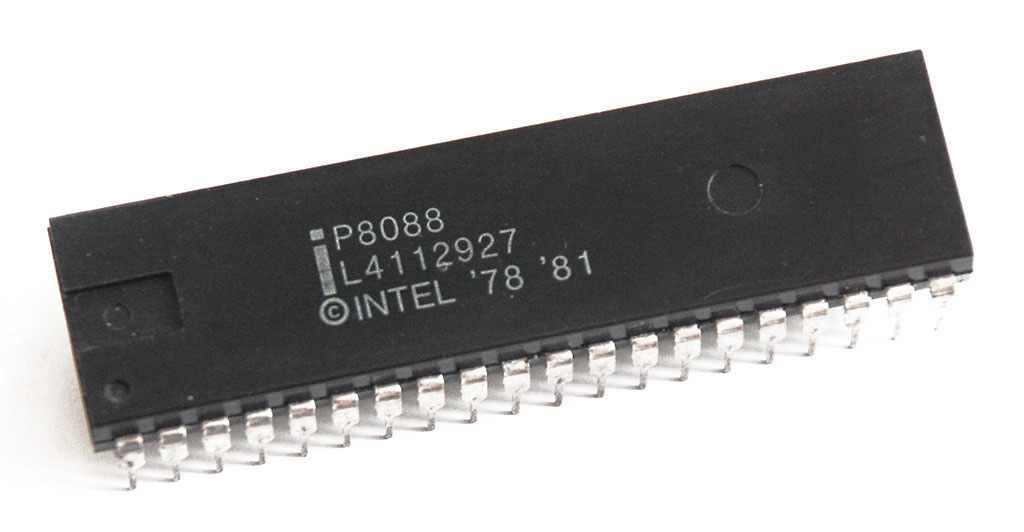
In the history of computing, only a handful of microprocessors can truly be described as world-changing. The Intel 8088, introduced in 1979, belongs in that select group.
At first glance, the 8088 does not seem particularly impressive by modern standards. It operated at just a few megahertz, contained fewer than 30,000 transistors, and could address only 1 MB of memory. Today's processors contain tens of billions of transistors and execute billions of instructions every second.
Yet the importance of the 8088 has little to do with its raw performance. Its significance comes from the fact that it became the heart of the original IBM Personal Computer in 1981. That single decision helped create the PC industry, established the x86 architecture as the dominant computing platform, and influenced processor design for decades.
Even now, nearly half a century later, modern x86 processors can trace their ancestry directly back to the architectural ideas introduced by the 8086 and 8088 family.
From the 8080 to the 8088
The story of the 8088 begins with Intel's earlier microprocessors:
4004 (1971)↓8008 (1972)↓8080 (1974)↓8085 (1976)↓8086 (1978)↓8088 (1979)
The Intel 8080 was one of the first truly successful microprocessors and powered pioneering systems such as the MITS Altair 8800, a machine that inspired many future computer entrepreneurs.
By the late 1970s, however, software was becoming larger and more sophisticated. An 8-bit architecture was beginning to show its limitations. Intel's answer was the 8086, a new 16-bit processor capable of addressing much larger amounts of memory.
The problem was cost.
A complete 16-bit computer required more expensive memory chips, wider circuit boards, and more complex support hardware. To make adoption easier, Intel created a companion processor: the 8088.
Internally, it was almost identical to the 8086. Externally, however, it communicated through an 8-bit data bus.
This seemingly small modification would change computer history.
The 8088 is often misunderstood as an "8-bit processor." In reality, it was a 16-bit processor with an 8-bit external data bus.
Think of it as a truck carrying cargo through a narrow road. The engine, transmission, and cargo compartment are all large and powerful, but the road connecting it to the outside world is narrower than ideal.
Intel 8088
==============================
16-bit
Registers
16-bit ALU
16-bit Internal
---
Processing---
│
▼
8-bit Data
Bus
│
▼
Memory & I/O
===============================
This design allowed computer manufacturers to use existing 8-bit memory systems and peripheral chips while still benefiting from a much more capable processor architecture. For IBM, this translated directly into lower manufacturing costs and a faster development schedule.
The Birth of the IBM PC
In 1980, IBM was racing to enter the emerging personal computer market. Traditionally, IBM designed everything internally, but this project moved unusually quickly. Engineers needed components that were readily available and well documented. After evaluating several options, IBM selected the Intel 8088.
The choice was pragmatic rather than revolutionary. The chip was available immediately. It offered 16-bit processing capability. Existing 8-bit hardware could still be used. Intel could provide long-term supply.
Few people realized at the time how consequential this decision would become. When the IBM PC 5150 was released in August 1981, it rapidly became the industry standard. Soon dozens of manufacturers began producing compatible "PC clones."
Because those machines had to run the same software, they also needed processors compatible with the 8088 instruction set.
The x86 ecosystem had begun.
Architecture Overview
One of the most interesting aspects of the 8088 is its internal organisation. Earlier processors generally executed instructions in a straightforward sequence:
+Fetch instruction
+Decode instruction
+Execute instruction
+---Repeat---^
The 8088 introduced a more sophisticated approach by dividing responsibilities between two major subsystems.
+------------------------+| Bus Interface Unit || (BIU) |+-----------+------------+|▼Prefetch Queue|▼+------------------------+| Execution Unit (EU) |+------------------------+
This separation allowed the processor to work on multiple tasks simultaneously.
The Bus Interface Unit (BIU)
The BIU was responsible for communication with the outside world. Its duties included:
-Fetching instructions from memory
-Reading and writing data
-Generating physical addresses
-Managing segment registers
-Filling the instruction queue
BIU could be thought as the logistics department of the processor.
While the rest of the CPU focused on calculations, the BIU continuously supplied it with instructions and data.
The Execution Unit (EU)
The Execution Unit performed the actual computation.
It contained:
+Arithmetic Logic Unit (ALU)
+General-purpose registers
+Flag register
+Instruction decoder
+Control circuitry
Whenever a program executed an addition, subtraction, comparison, or branch instruction, the EU handled the operation.
The EU was essentially the "brain" of the processor, while the BIU acted as its connection to memory and peripherals.
The Innovation of Instruction Prefetching
One of the most advanced features of the 8088 was its instruction prefetch queue.
Modern CPUs use deep pipelines and sophisticated caching systems. The 8088 represented an early step toward those ideas.
Memory│▼+----------------+| Prefetch Queue || [ ][ ][ ][ ] |+----------------+│▼Execution Unit
The BIU continually fetched upcoming instructions before the Execution Unit actually needed them. This meant the processor spent less time waiting for memory accesses. Although simple by modern standards, this was a remarkably forward-looking design concept.
+Memory Segmentation: Solving a Difficult Problem.
The processor used 16-bit registers. A pure
16-bit address space would allow only: 65,536
bytes = 64 KB. That was already becoming
restrictive. Instead of using a single address value,
Intel's processor combined:
Segment = 1234h
Offset  = 5678h
Physical Address
= 12340h + 5678h
= 179B8h
Segment = 1234h
Offset = 5678h
Physical Address
= 12340h + 5678h
= 179B8h
This scheme allowed the processor to access:
1,048,576 bytesIn
1979, one megabyte seemed enormous.
=
1 MB
Many computer systems of the era contained only 16 KB or 64 KB of RAM.
Looking Inside the Silicon
Examining an 8088 die is fascinating because the internal structure is surprisingly visible.
Unlike modern processors, which are packed with billions of transistors, the 8088's architecture can actually be identified by eye. Major functional areas include:
+Register arrays
+Microcode ROM
+Bus control circuitry
+Arithmetic logic unit
+Instruction decoding logic
Timing circuits
The entire processor contains roughly 29,000 transistors.
| Processor :
Transistors
| -------------- : -------------
|
8088 :
29,000
| 80386
: 275,000
|
Pentium : 3.1
million
| Modern Core CPU : 10–50+ billion
The growth is staggering. A modern desktop processor may contain over a million times more transistors than the 8088.
The Optional Math Coprocessor
For scientific and engineering applications, Intel offered the 8087 Numeric Coprocessor.
8088 + 8087↓Faster Floating-Point Math
The 8087 could perform: Trigonometric calculations, Floating-point arithmetic, Scientific computations. This was one of the earliest examples of a specialized processor accelerating specific workloads.
Today's GPUs and AI accelerators follow the same basic philosophy.
Why the 8088 Changed the World
The technical innovations of the 8088 were important, but its greatest impact was economic and historical.
Without the 8088:
-IBM might have selected a different architecture.
-PC clones may never have become standardized.
-Software compatibility might have fragmented.
-x86 might never have become dominant.
Instead, the opposite occurred.
The processor became the foundation for an ecosystem that eventually produced:
8088
↓
80286
↓
80386
↓
80486
↓
Pentium
↓
Core
Series
↓
Modern x86 CPUs
Every major Intel and AMD desktop processor still carries DNA inherited from the 8088.
Legacy
The Intel 8088 was not the fastest processor of its era. It was not the most elegant. It was not even Intel's most technically advanced design. Yet it was arguably the most influential. By combining a modern 16-bit architecture with the affordability of existing 8-bit systems, Intel created a processor that was attractive to manufacturers, practical for IBM, and powerful enough for the emerging software industry.
The result was a technological chain reaction that helped transform computers from specialised machines into everyday tools.
Today, when a modern PC boots an operating system, runs software, or executes x86 machine code, it is participating in a lineage that began with a humble 40-pin chip released in 1979—the Intel 8088, the processor that launched the personal computer revolution.
+++
Related articles
The Pentium CPU Revolution // Part-3
From Pentium to Modern CPUs: The Legacy of a Revolution
The Pentium CPU Revolution // Part-1
How Intel's Pentium Processor Changed Computing Forever
The Intel 4004: The World's First Microprocessor
How a humble calculator chip from 1971 packed an entire CPU onto a single sliver of silicon and launched the computing revolution.