The Pentium CPU Revolution // Part-1
How Intel's Pentium Processor Changed Computing Forever
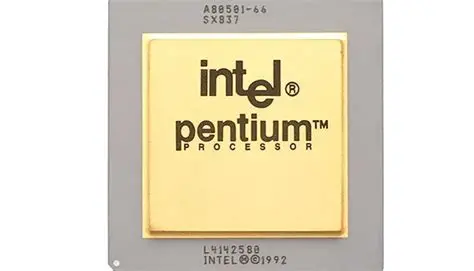
The Pentium Revolution
How Intel's Pentium Processor Changed Computing Forever
Few technological inventions have transformed modern society as profoundly as the microprocessor. Hidden beneath the heatsink of every desktop computer, laptop, game console, and server is a tiny piece of silicon capable of executing billions of instructions every second. Today's processors contain tens of billions of transistors, but their ancestry can be traced back to humble chips built from only a few thousand electronic components.
Among these milestones, one processor stands apart as the point where personal computing truly entered the modern age: the Intel Pentium.
Released in 1993, the Pentium was much more than just another faster processor. It introduced architectural innovations that fundamentally changed CPU design. It was Intel's first mass-market superscalar x86 processor, capable of executing multiple instructions simultaneously. It brought advanced branch prediction, wider data buses, faster floating-point performance, and multimedia capabilities that enabled the explosion of 3D gaming, the Internet, CAD software, and digital media.
For many people, "Pentium" became synonymous with "computer." It was not unusual to hear someone say, "I bought a Pentium," rather than "I bought a PC."
To appreciate why the Pentium was revolutionary, we must first travel back to the beginning of the microprocessor era.
Before the Pentium
During the early 1970s, computers were enormous machines occupying entire rooms.
A typical computer consisted of:
- Separate CPU boards
- External arithmetic units
- Memory cabinets
- Massive power supplies
- Thousands of integrated circuits
Only governments, universities, and large corporations could afford them.
Everything changed when engineers discovered they could place an entire CPU onto a single silicon chip.
Birth of the Microprocessor
In 1971 Intel introduced the world's first commercial microprocessor:
Intel 4004
Specifications
Year:              1971
Clock Speed:       740 kHz
Word Size:         4-bit
Transistors:       2,300
Address Space:     640 Bytes
Although primitive, it proved that an entire CPU could fit inside one integrated circuit.
The age of personal computing had begun.
Evolution of Intel CPUs
1971
Intel 4004
      │
      ▼
1972
Intel 8008
      │
      ▼
1974
Intel 8080
      │
      ▼
1978
Intel 8086
      │
      ▼
1982
Intel 80286
      │
      ▼
1985
Intel 80386
      │
      ▼
1989
Intel 80486
      │
      ▼
1993
PENTIUM
Each processor doubled—or even tripled—the capabilities of its predecessor.
The Intel 8086 (1978)
The 8086 established what would become the world's most successful processor architecture: x86.
Its design still influences every Intel and AMD processor today.
Specifications
| Feature | Value |
|---|---|
| Word Size | 16-bit |
| Address Bus | 20-bit |
| Max Memory | 1 MB |
| Registers | 14 |
| Transistors | 29,000 |
| Clock Speed | 5–10 MHz |
8086 Register Layout
               8086 CPU

+-------------------------------+
| AX   Accumulator              |
| BX   Base Register            |
| CX   Counter                  |
| DX   Data Register            |
+-------------------------------+

+-------------------------------+
| SI  Source Index              |
| DI  Destination Index         |
| BP  Base Pointer              |
| SP  Stack Pointer             |
+-------------------------------+

+-------------------------------+
| CS  Code Segment              |
| DS  Data Segment              |
| ES  Extra Segment             |
| SS  Stack Segment             |
+-------------------------------+

Instruction Pointer
IP

Flags Register
FLAGS
These registers became the foundation of x86 programming.
Many are still present today, now expanded to 64 bits.
Memory Segmentation
Unlike modern processors, the 8086 could not directly address memory using a flat address space.
Instead, it used segments.
Physical Address

Segment × 16
      +
Offset
      =
Memory Address
Example
Segment = 2000h
Offset  = 0030h

Physical Address

20000h
+0030h
------
20030h
Although awkward, this allowed Intel to address 1 MB of memory using 16-bit registers.
The Intel 80286 (1982)
The 286 represented a significant leap forward.
New features included:
- Protected Mode
- Hardware memory protection
- Multitasking support
- Larger memory addressing
Specifications
Word Size      16-bit
Clock          6–25 MHz
Transistors    134,000
Memory         16 MB
Protected Mode laid the groundwork for modern operating systems.
The Intel 80386 (1985)
The arrival of the 386 was arguably the second most important event in x86 history.
It introduced:
✔ 32-bit registers
✔ 32-bit instructions
✔ Virtual Memory
✔ Paging
✔ Flat Memory Model
Register Expansion
8086

AX
BX
CX
DX

↓

80386

EAX
EBX
ECX
EDX
The "E" stands for Extended.
Instead of 16 bits...
AX

+-+-+-+-+-+-+-+-+
|16 bits        |
+-+-+-+-+-+-+-+-+
The processor now supported
EAX

+-+-+-+-+-+-+-+-+-+-+-+-+-+-+-+-+
|            32 bits            |
+-+-+-+-+-+-+-+-+-+-+-+-+-+-+-+-+
This allowed software to manipulate much larger numbers and memory addresses.
The Intel 80486 (1989)
The 486 represented the pinnacle of pre-Pentium design.
It introduced:
- On-chip cache
- Integrated Floating Point Unit
- Five-stage pipeline
- Improved instruction execution
Specifications
| Feature | Value |
|---|---|
| Clock | 25–100 MHz |
| Transistors | 1.2 Million |
| Cache | 8 KB |
| FPU | Integrated |
486 Pipeline
Unlike earlier processors that largely completed one instruction before starting another, the 486 overlapped stages of multiple instructions.
Clock →

Instruction A

Fetch
    Decode
        Execute
            Memory
                Write Back

Instruction B

    Fetch
        Decode
            Execute
                Memory
                    Write Back
This dramatically increased throughput.
Moore's Law
In 1965, Gordon Moore predicted that the number of transistors on integrated circuits would roughly double every couple of years.
His observation became known as Moore's Law.
Year        Transistors

1971         2,300

1978        29,000

1982       134,000

1985       275,000

1989     1,200,000

1993     3,100,000
The Pentium was the first Intel processor to exceed three million transistors, an extraordinary engineering achievement for its time.
Why Intel Needed Something New
By the early 1990s, software had become far more demanding.
Applications such as:
- Windows graphical interfaces
- CAD software
- Scientific simulations
- MPEG video
- JPEG image processing
- 3D games
- Computer-aided engineering
required much more processing power than the 486 architecture could efficiently deliver.
Increasing clock speed alone was no longer enough.
Intel engineers faced several challenges:
- Memory was becoming a bottleneck.
- Floating-point calculations were too slow for emerging 3D graphics.
- Pipelines frequently stalled because of branch instructions.
- A single instruction pipeline limited overall performance.
The solution would require a radical redesign rather than another incremental upgrade.
That redesign became the Pentium.
For the first time in an x86 processor intended for mainstream PCs, Intel implemented dual instruction pipelines, allowing the CPU to execute more than one instruction during a single clock cycle. Combined with a wider 64-bit external data bus, improved branch prediction, separate instruction and data caches, and a much faster floating-point unit, the Pentium marked the beginning of the superscalar era.
These innovations would influence processor design for decades to come.
Related articles
The Pentium CPU Revolution // Part-3
From Pentium to Modern CPUs: The Legacy of a Revolution
The Pentium CPU Revolution // Part-2
Part 2 – Inside the Pentium: The Architecture That Changed CPU Design
The 8088 arrival and influence
the importance of the 8088 cpu